Boiler Replacement Cost in Korea: ₩1,045,000, All In
Someone has looked at your boiler and said the word 교체 — replacement. Maybe it’s fifteen years old, maybe the third part in a season has failed. The next question is always the same, and nobody answers it in English: what does a new boiler actually cost in Korea?
Here is one real answer, with the receipt behind it.
The number, twice
We have two real receipts for the same job, four years apart. Together they do something a single price never can: they show the number is stable.
December 2021 — a Navien condensing boiler, supplied and fitted
| Line | Amount |
|---|---|
| Unit and installation | ₩950,000 |
| VAT (부가세, 10%) | ₩95,000 |
| Total paid | ₩1,045,000 |
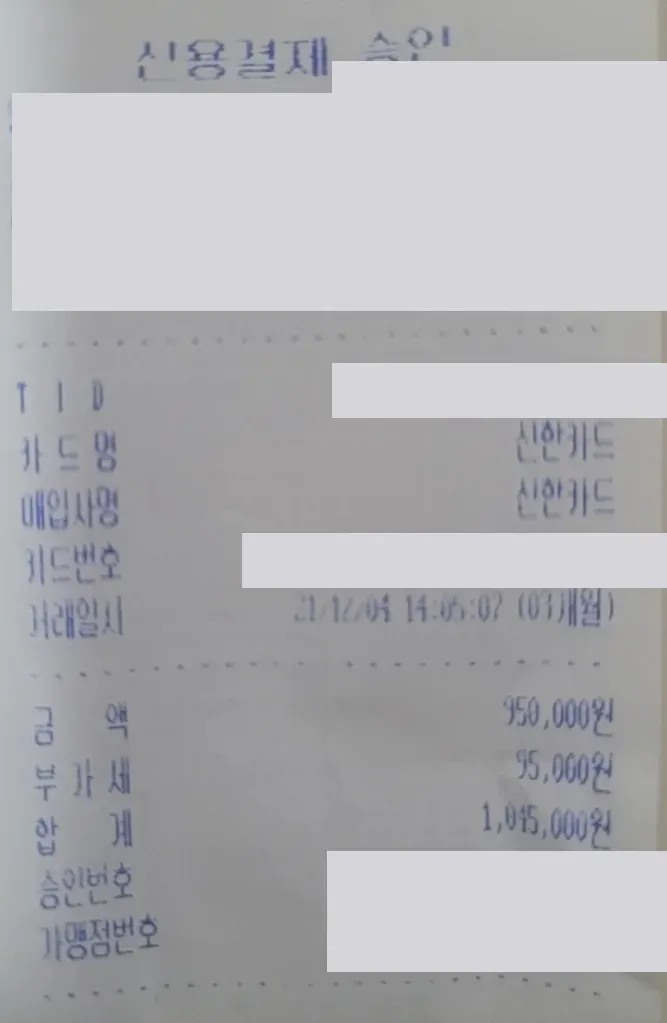
The 2021 card slip — merchant and card details redacted · ⓒ @BalliBalliSeoul
The transaction date is on it — 21/12/04, paid over three monthly instalments — along with the split between the price and the VAT.
January 2026 — another 22K unit, same job
| Line | Amount |
|---|---|
| Boiler replacement, all in | ₩900,000 |
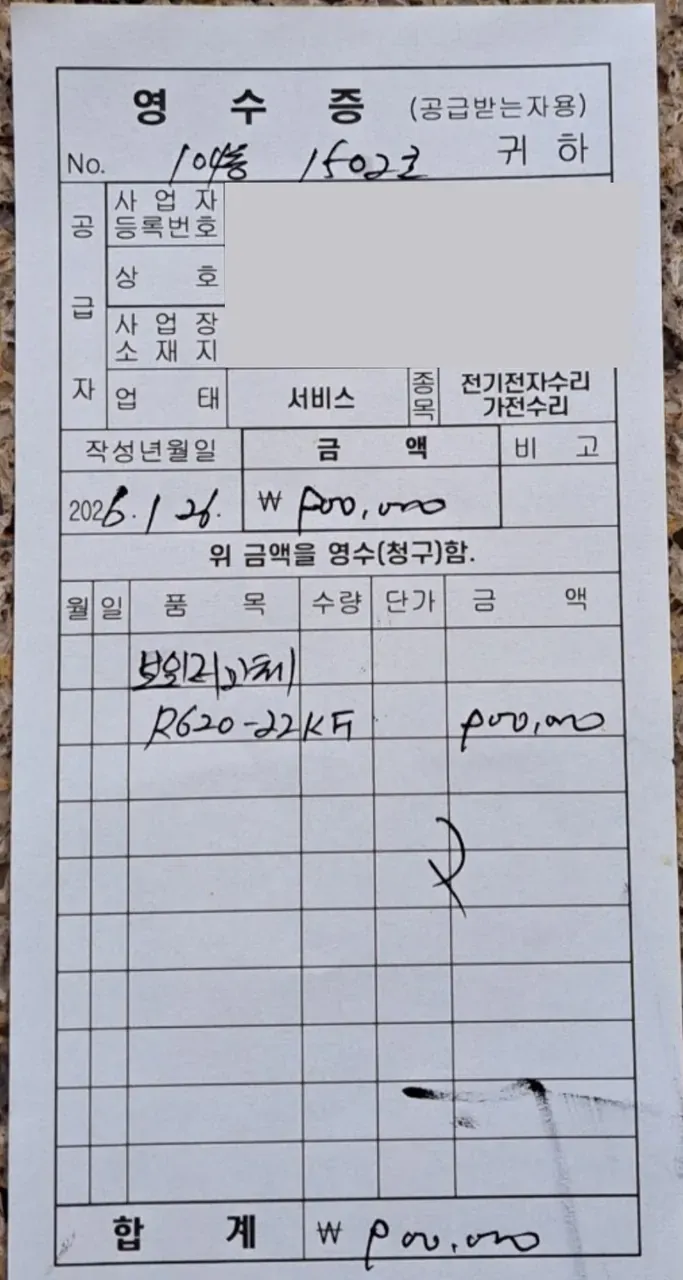
The 2026 receipt — installer’s details redacted, everything else as issued · ⓒ @BalliBalliSeoul
That is the second receipt as we received it: a handwritten 영수증 with the date, the item line — 보일러(교체) R620-22KF — and the total. There is no separate VAT line, which is normal for a small independent installer working off a receipt book rather than a card terminal.
On both receipts we have blanked the same things — the business’s registration number, name, address and bank or card identifiers. They are private businesses that never agreed to appear here, and the numbers are the point, not them. Everything that matters for checking a quote is still readable: the date, the item, the amounts.
Same capacity class, same city, a slightly lower number four years later.
What that means for you
Plan on roughly ₩900,000 – ₩1,050,000 for a mid-size condensing boiler supplied and fitted in Seoul — about US$625 – 730 at ₩1,440 to the dollar. That is the whole bill: the boiler, the fitting, the old unit taken away.
Two dated receipts four years apart is not a market survey, but it is two more than most people get before they say yes to a quote. If a number comes back at two or three times this, you now know enough to ask why — and to get a second quote before agreeing.
What moves the price is capacity, fuel type and how awkward the installation is — not the brand badge. A bigger flat needs a bigger unit. A boiler in a tight balcony recess with old pipework costs more to fit than a straight swap.
What the box actually tells you
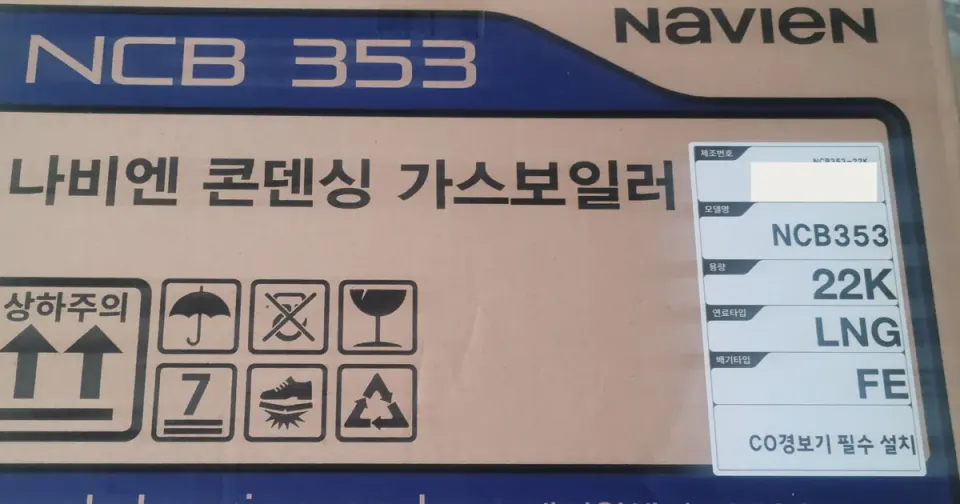
Korean boilers carry their entire specification on one label, and once you can read four fields you can check that the unit being fitted is the unit you agreed to. This one:
| Field | Value | What it means |
|---|---|---|
| 모델명 (model) | NCB353 | Navien’s condensing series |
| 용량 (capacity) | 22K | ~22,000 kcal/h — sized for a typical flat |
| 연료타입 (fuel) | LNG | City gas. The other option is LPG — they are not interchangeable |
| 배기타입 (flue) | FE | Forced exhaust — a fan pushes flue gas out, so it can sit indoors |
Check the fuel type before anything is unboxed. LNG and LPG boilers look identical and are not the same appliance. Most Seoul flats are on city gas (LNG), but if you are outside the mains network you may be on LPG cylinders, and a wrong unit is a wasted day at best.
콘덴싱 (condensing) is the part that shows up on your bills. A condensing boiler recovers heat from its own exhaust instead of throwing it out of the flue. The one above is rated 에너지소비효율등급 1 — energy efficiency grade 1, the top band — at 92.1% heating efficiency. Korea has pushed hard toward condensing units for exactly this reason, and there are government subsidy schemes for eco-friendly boiler replacement. Ask your installer whether your replacement qualifies, because the paperwork is theirs to file and they will not volunteer it.
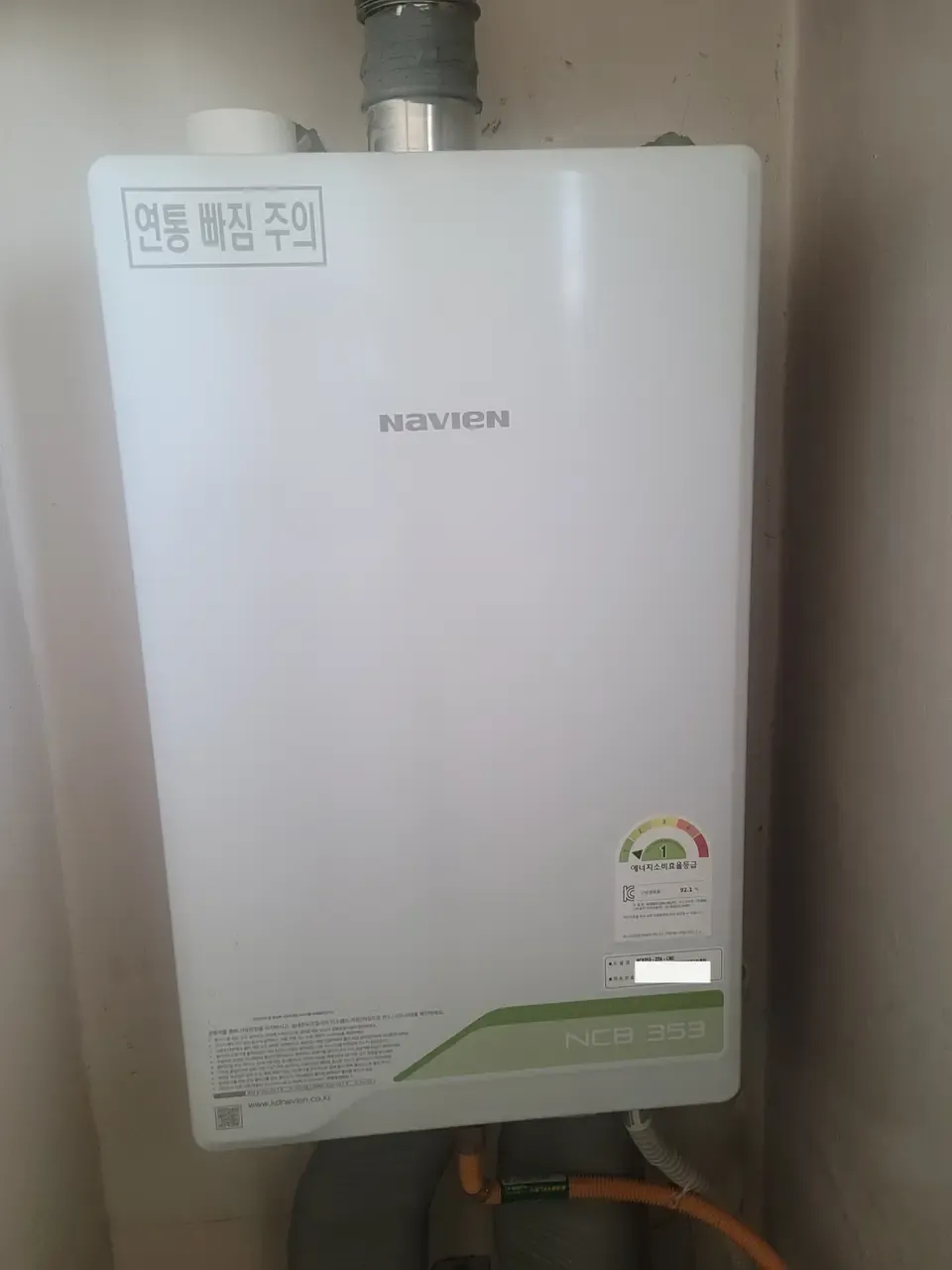
The same unit, fitted — energy grade 1, 92.1% · ⓒ @BalliBalliSeoul
The line on the box that is not marketing
Printed on the label, under the spec fields: CO경보기 필수 설치 — carbon monoxide alarm installation required.
That is not a suggestion from the marketing department. A gas boiler that burns imperfectly produces carbon monoxide, which has no smell and no colour, and Korea has had fatal accidents from flue pipes that worked loose. The installed unit above carries a second warning stencilled on its own casing — 연통 빠짐 주의, caution: flue detachment — which tells you what the industry actually worries about.
Two things follow from that, and they cost almost nothing:
- Make sure a CO alarm is fitted and working. If the installer doesn’t raise it, raise it yourself.
- Look at the flue pipe occasionally. It should be firmly seated where it leaves the boiler and where it passes through the wall. If it looks separated or you see soot marks, that is a same-day call, not a next-week one.
Before you agree to a replacement
Replacement is the expensive answer, and it is not always the right one. Intermittent hot water — hot, then cold, then hot again — usually points at a single valve rather than a dead boiler, and that is a sub-₩100,000 repair. We wrote that one up separately because it is the most common false alarm.
The honest signals that it really is the boiler:
- Age. Domestic boilers run around 8–10 years. Past ten, worn internals burn less cleanly — rising gas bills, and more carbon monoxide.
- Repeated failures. One valve is a repair. Three call-outs in a season is a boiler telling you something.
- The efficiency argument. Replacing a fifteen-year-old conventional unit with a grade-1 condensing one is not only about breakdowns; it changes what you pay every winter.
Who pays — and this is the important bit
If you are renting, on either 월세 (monthly rent) or 전세 (deposit lease), this is usually not your bill.
Korean civil law puts the duty of keeping a rented property usable on the landlord, and a boiler is not decoration — it is the equipment that makes the flat habitable in winter. Replacement due to age or ordinary wear therefore falls to the landlord (집주인), the same as a leaking roof. What tenants are generally responsible for is damage they actually caused — a boiler frozen because the flat was left unheated through a cold snap, for example.
Why landlords agree more readily than you’d expect
This is the part worth knowing before you open the conversation, because it changes its tone completely.
A boiler replacement is not money your landlord simply loses. In Korea it counts as a 자본적 지출 (jabonjeok jichul) — a capital improvement to the property, rather than routine upkeep. When they eventually sell, that spend is treated as a 필요경비 (piryo gyeongbi), a necessary expense: the capital gains tax is calculated on the sale profit minus costs like this one.
So the money partly comes back to them at sale, on a piece of equipment that had to be replaced sooner or later anyway. Owners generally know this. It is why “the boiler is fifteen years old” is a far easier conversation than “I’d like new wallpaper” — wallpaper and flooring are treated as ordinary upkeep and don’t get the same treatment.
Two practical consequences for you:
- The paperwork has to be in their name. A proper tax invoice (세금계산서) or a card or bank record showing the landlord as the payer is what makes the expense claimable later. If you’re the one arranging the work, make sure it is billed to them, not to you — otherwise you have handed them a cost they can’t use and a reimbursement argument you don’t need.
- You can say this out loud. Politely, and as context rather than as a lecture: this is a replacement, not a redecoration, and it doesn’t disappear from their books.
(Tax rules and what counts as adequate documentation do change, and their tax position is theirs, not ours to advise on — treat this as the reason the answer is often yes, not as a promise about their return.)
So the sequence matters:
- Report it, in writing, before anything is agreed. A message with the date and the symptom is enough, and it is your evidence later.
- Do not commission the replacement yourself and expect to be reimbursed. Get the landlord’s agreement first, even if you arrange the fitting.
- Keep the receipt — like the one this article is built on. It is what settles a deposit argument at move-out.
If your building is managed, the 관리사무소 (management office) often has a boiler firm it already uses, which is usually faster and rarely more expensive.
If you own the flat, it’s yours
None of that applies if you bought the place. There is no landlord to ask — the boiler is your equipment and that ₩900,000-odd is yours to find.
The same tax logic works for you, though, which is the argument for doing it properly rather than cheaply: keep the receipt. When you sell, a boiler replacement is the kind of capital expense that comes off your taxable gain, and the document that makes it count is exactly the sort of receipt this article is built on. File it with your purchase paperwork the day it arrives — it may be years before it matters, and by then you will not remember which drawer it went into.
The Korean part
Nothing above is complicated. It is just that all of it happens in Korean — the diagnosis on the phone, the quote that arrives as a text message with no breakdown, the argument about whether this is wear or misuse, and the landlord conversation that decides who pays.
That last one is where most foreign tenants lose money. Not because they are wrong, but because making the case in Korean, to a landlord who would rather patch it again, is hard.
That is what we do. Send us the symptom, the quote you were given, or the message from your landlord, and our English-speaking plumbing service will read it, tell you whether the number is fair, and make the call in Korean.
Been quoted for a boiler? Send us a photo of the quote and of the boiler on WhatsApp — we’ll tell you what the spec means and whether the price is in the normal range. Asking costs nothing — you pay only for the work you book.
The one-line version: a condensing gas boiler fitted in Seoul lands between ₩900,000 and ₩1,050,000, check that 용량 and 연료타입 match your flat, insist on the CO alarm — and if it’s age or wear, the bill belongs to your landlord, who can write it off against their gain when they sell.