TOPIK Explained: Levels, Why It Matters, How to Study
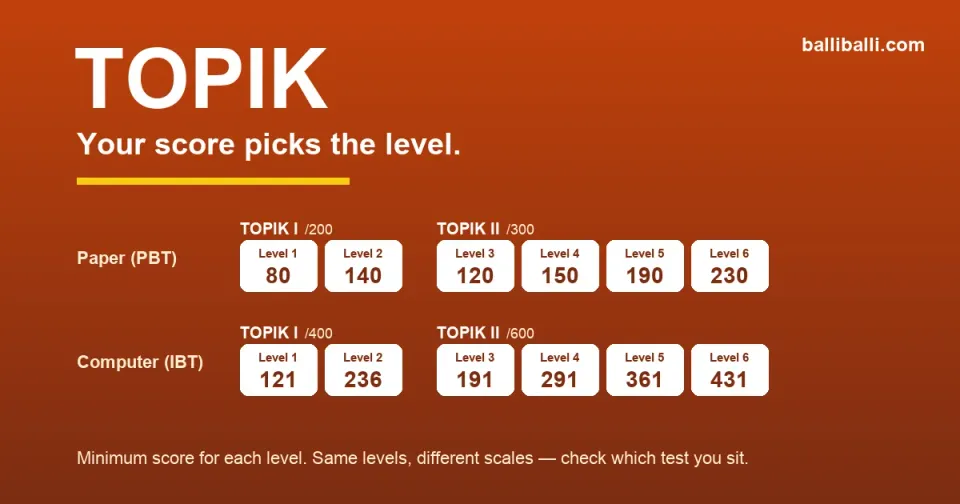
At some point living here, Korean stops being a hobby and starts being paperwork. A university application asks for a level. A visa points table gives you credit for one. An employer asks which one you have.
The thing they are all asking about is TOPIK, and almost nobody explains it to you before you need it.
What TOPIK actually is
TOPIK — the Test of Proficiency in Korean — is the official Korean-language exam, run by a Korean government institute and held several times a year, both inside Korea and at test centres overseas.
Two things surprise people:
You do not pick your level. You pick a paper, sit it, and your level is decided by your score. There is no “I’ll take the level 4 exam.”
There are two papers:
| Paper | Awards | Sections |
|---|---|---|
| TOPIK I | Level 1–2 | Listening, reading |
| TOPIK II | Level 3–6 | Listening, writing, reading |
TOPIK I is for beginners and has no writing section. TOPIK II is the one that matters for most official purposes, and it includes written composition — which is where unprepared candidates lose most of their marks.
The writing section is where the two formats differ most. On paper it is four questions, and the shape of it surprises people: two short answers where you supply the missing phrase yourself, then two essays — one on an everyday topic, one asking for your opinion on an issue and expecting it argued. On computer it is three questions in 50 minutes, typed. Either way there is no multiple choice and nothing to guess at.
TOPIK now comes in two formats — the traditional paper test and a computer-based one — and in 2026 each runs six times in Korea, most of those sittings also at test centres abroad.
Your score picks the level — here are the numbers
This is the part that is hard to find in one place, and it is worth knowing before you book anything, because it tells you what you are actually aiming at.
| Test | Total | Level 1 | Level 2 | Level 3 | Level 4 | Level 5 | Level 6 |
|---|---|---|---|---|---|---|---|
| TOPIK I — paper | 200 | 80 | 140 | — | — | — | — |
| TOPIK II — paper | 300 | — | — | 120 | 150 | 190 | 230 |
| TOPIK I — computer | 400 | 121 | 236 | — | — | — | — |
| TOPIK II — computer | 600 | — | — | 191 | 291 | 361 | 431 |
The two formats award the same levels on different scales, so a score means nothing until you know which test it came from: 230 is level 6 on paper and only level 3 on computer.
Read it as a floor: score 150 on paper TOPIK II and you are level 4; score 149 and you are level 3. There is no rounding and no appeal to how close you were.
Two things fall out of that table. On the paper scale the jump from 3 to 4 is 30 points and from 4 to 5 is 40 — the middle is where the work is. And sitting the wrong paper caps you: TOPIK I cannot award you level 3 no matter how well you do, so if level 3 or above is what you need, TOPIK II is the paper even if it feels a stretch.
Paper or computer: PBT and IBT
The paper test is called PBT and the computer test IBT. They carry the same official standing and the same levels, and a result from either is valid for two years. What differs is the day itself.
| Paper (PBT) | Computer (IBT) | |
|---|---|---|
| How you answer | Marking and handwriting, with a double-ended pen the invigilator hands you | A test-centre PC, with a Korean keyboard |
| Writing (TOPIK II) | Four questions, handwritten inside fixed boxes | Three questions in 50 minutes, typed |
| Breaks | TOPIK II has a break between its two sittings | None |
| Fee in Korea (I / II) | ₩40,000 / ₩55,000 | ₩70,000 / ₩95,000 |
| Results, 2026 example | 18 October sitting → 10 December | 28 November sitting → 18 December |
On paper you cannot bring your own pen or pencil — answers must be written with the one you are given, and writing outside the answer box scores nothing. Correcting an essay means two lines through the mistake or correction tape you bring yourself; test centres stopped supplying it in 2020.
On computer, the question is whether you can type Korean quickly. If you have only ever handwritten Korean, fifty minutes on a keyboard is a different test of the same knowledge. If you already type Korean every day, the faster results and the absence of a pen you cannot rub out are real advantages.
Registering: the parts that catch foreigners out
Registration happens online at topik.go.kr, in a window of about a week, roughly ten weeks before each sitting. Most of it is routine. These are the parts that stop people, taken from the official notice for the 2026 computer-based sittings:
- A Windows computer only. The site does not accept registration from a Mac or a phone
- No foreign cards. Cards issued abroad and overseas transfers cannot pay the fee — you need a Korean card or a Korean bank account for the virtual-account option
- Pay within an hour. You have one hour after applying to choose a payment method, or the application is cancelled
- Your name must match your ID exactly, English spelling included. A mismatch means you cannot sit the test
- The photo has rules: the immigration ARC photo standard, taken within six months, 413×531 pixels, JPG or PNG, under 500KB
- One account, one test centre. You can sit TOPIK I and TOPIK II at the same centre on the same day
- Small centres can be cancelled. A centre with 15 or fewer applicants may be dropped, with a full refund
- Refunds shrink over time: in full until the last morning of registration, then 50% for a week, then 40% up to the day before the test
Online registration on that site is for sittings in Korea. Abroad, you register through the local test organiser. The TOPIK call centre in Korea is 02-3668-1331.
As of 15 September 2026: registration for the 16th computer-based TOPIK, held on 28 November, is open until 21 September at 16:00 KST. In Seoul it runs at Korea, Konkuk and Sungshin Women’s universities, with Seokyeong University added for TOPIK II.
What the levels are actually for
This is the part worth knowing before you choose a study plan, because the level you need depends entirely on why you are taking it:
- University admission. Korean-taught undergraduate and graduate programmes generally want a mid-to-upper TOPIK II level. Each university sets its own bar, and they are not identical
- Visas and residency. Korea’s points-based residency tracks award credit for Korean ability, and TOPIK is the standard proof
- Employment. Korean companies hiring foreign staff often state a level in the job posting
- Scholarships, including the government ones, set their own minimums
The practical implication: find out the exact number your target asks for, then aim one level above it. Nobody has ever regretted that; plenty of people have missed a cutoff by a few points.
Because requirements and test dates change, check the official site — topik.go.kr — rather than a blog post, including this one, for anything you are going to plan around.
How people actually study
There is no shortage of apps and textbooks. What separates people who get the level from people who keep almost getting it is duller than that.
Past papers, early and often. TOPIK is a specific exam with a specific shape, and the single highest-return activity is sitting old papers under time pressure. Past questions are published. Doing one cold, right at the start, tells you your real starting point better than any placement quiz.
The clock is the real opponent — particularly in reading. Many candidates know enough Korean and still run out of time, because they read every passage the way they read a book. Learning to skim for the answer is a test skill, not a language skill, and it is trainable.
Writing is where TOPIK II is won or lost. It is the section self-studiers neglect, because it is the only one you cannot mark yourself. Composition needs a human to correct it — and this is the single strongest argument for having a teacher rather than an app.
Vocabulary by level, not by vibe. Level-graded vocabulary lists exist for a reason. Learning words you like is pleasant; learning the words the exam uses is what moves the score.
Listening rewards volume. Drama with subtitles is entertainment. Drama without subtitles, radio, podcasts — that is training.
If you sit the computer test, practise typing Korean. The keyboard layout is not the problem after a week; speed under a clock is. Do past essays typed, timed, with no autocorrect.
Self-study, class, or a teacher?
Honestly, all three work, for different people:
- Self-study is cheapest and works if you are disciplined and already have a grammar base. Its weak point is speaking and writing — the two things nobody can correct alone
- Language institutes attached to universities are thorough and structured, and they are a serious time commitment on a fixed timetable — though several now run evening and online courses that a working schedule can actually take. Seoul also runs free classes, and the whole range is laid out here: how to learn Korean in Seoul
- A tutor is the flexible middle: your schedule, your weak areas, and someone marking the writing you cannot mark yourself
If you are working, the tutor route usually survives contact with real life better than a fixed class timetable.
🇰🇷 Want a Korean teacher? We can introduce you

Rim, one of the teachers we introduce · ⓒ Balli Balli Seoul
This is something we arrange, so it is worth stating plainly:
We can introduce you to a Korean teacher.
- All lessons run online, by video call — so it does not matter which country or time zone you are in
- In Seoul? Ask about in-person lessons as well
- Tell us your current level, what you are aiming at, and roughly when you are free
Not taking the exam? That is the more common request, in fact. Everyday conversation, the Korean for specific situations, or just someone to practise speaking with are all normal things to ask for — we wrote about that separately.
Message us on KakaoTalk or WhatsApp and we will come back with options. Asking costs nothing — you pay only for the work you book.
What we offer, and what it costs, is on our Korean lessons page — including a free ten-minute call with a teacher before you commit to anything. Say if you are working towards TOPIK, and which level you need, because exam prep and conversation practice are not the same lesson.
To be straightforward about what this is: we make the introduction and handle the arrangement. Teaching is delivered by the teacher, and we do not promise a test result — no one honestly can. What we can do is find you someone suitable, in your language, and sort out the scheduling and the Korean-language part of the admin.
Studying here, living here
One thing worth saying to anyone about to start: the fastest progress comes from needing the language, not from studying more hours. People who handle their own deliveries, appointments and building-office conversations in Korean improve faster than people who study twice as hard and outsource every real interaction.
That said, some errands are a bad place to practise. A contract, a hospital visit or a dispute with a landlord is not a language exercise — that is what our anything-else concierge service is for, and the clinic guide and renting guide cover the two that come up most.
Practise on the coffee order. Get help with the lease.
Get it sorted
The one-line version: TOPIK I awards levels 1–2, TOPIK II awards 3–6, your score picks the level rather than you — on a different scale for the paper and computer tests — writing is where most people lose marks, and past papers under a clock beat any app. Check topik.go.kr for the dates and the exact requirement — and if you want a teacher, ask us.